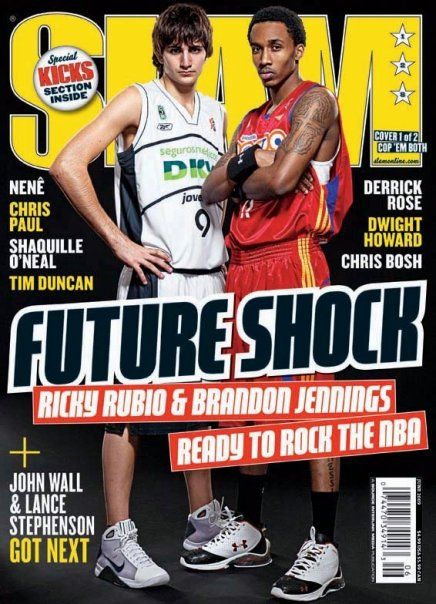
 "[Brandon] Jennings and John Wall are the future!"
Says a poster from the comment thread on Jenning's new facbook video...
But are they [Wall and Jennings] indeed the future? When did this phenomenon of "the future" come about? And what does it mean to be "the future" anyway?
1.) First, I shall answer the latter question. Being the future, simply put, means for that player to be one of the next talents in a long line at that position to be considered a "role model" to the youth, a vicarious instruments to his peers & elders, and the apex of talent at his position to his sport.
2.) But when (or better yet, how) did this phenomenon come about? And why is it now so important for us to proclaim an individual as "the future"? In human history their has always been an innate want for us to see "what's coming next" or to "read the future." This phenomenon of acknowledging "the future" is simply a play on that particular concept. However this concept, as related to basketball, was greatly accelerated with the appearance and conclusion of the accepted GOAT of the NBA, Michael Jeffrey Jordan. It all started with people wanting to "Be like Mike". Then as Jordan retired, un-retired, and then began to cruise closer to the end of his career the question came up, from where (the human psyche?) no one exactly knows, but it came up. The question: Whose the next guy to "Be Like Mike"? Was it Harold Miner? Isaiah Rider? Grant Hill? Vince Carter? No, it wasn't. In fact, Kobe Bryant has been the closest next MJ, but even his resume is not quite there.
What was the point of this whole diatribe, listing so many names? Well it was through MJ that the seeds were planted; through his global iconic status, unparalleled marketability, athleticism, talent, winning prowess, competitive fire, and undeniable charisma. But MJ leaving would create a void and who would be able to fill it? We'd need someone wouldn't we? MJ would have to be replaced and a replacement was needed yesterday. It was through THAT motivation that it all started. Then came the epic failures of the first "next MJs" (particularly Grant Hill) that further elevated the need, creating the media's version of a reverse-witch hunt, a hysteria. Kobe Bryant appeared on his way to near-Jordan status, but something was amiss and the media had to have a backup plan, they couldn't put their eggs all into one basket (and with Kobe's rape charge soon to come, they planned well).
So as perhaps the most dominant high school basketball phenom ever arrived onto the scene (LeBron James), naturally, the media followed. The media came early and they followed him every step of the way, waiting, seeing, watching. Would he be the next MJ? 7 years into the future and with LeBron going Heat, we have our answer. But LeBron did however succeed like no other high school player before him and peaked the interest of many-a-media outlets. LeBron's situation was unparalleled, never had their been a situation before where the media followed a high school player so heavily and throughout the entire process. So then "the question" was not so much the motivation any longer. The motivation became to find the next basketball "prodigy" and the age became younger and younger.
First their was OJ Mayo, a prodigy since middle school (appearing in Sports Illustrated in 7th grade), then there was Greg Oden, next arrived Lance Stephenson, DeMarr Derozan, Tyreke Evans, Brandon Jennings, Derrick Rose, and the latest entry John Wall. After Stephenson however (whose fame also started in middle school) the hysteria and hype shrunk lower... literally. The reason the hype for DeRozan and on weren't as high was because the hype moved from high school and middle school to yes, elementary-schoolers. Who are supposed to be the next prodigies, you ask? A quick Google search and Jayshaun Augosto, Jaylin Flemming, and Jerron Love populate the page. However, this isn't an ethical piece, I won't mention the possible psychological concerns that will face the young prodigies as they grow, such is not my intent (not with this piece anyway).
My intent however was to explain the origins and the current result of the notion of "the future." To review: It started with MJ, Grant Hill failing accelerated the need, Kobe wasn't there, LeBron transformed hype, "phenoms" followed, and now "prodigies" have arrived. But back to the second part of this question: "Why is it now so important for us to proclaim an individual as 'the future'?" It's important for us to proclaim someone as such because it gives us the "weatherman sense", the sense that we can predict the future, that we are indeed agents of time, or like they're called in the history books, literary epics (such as Oedipus), and awesome movies like the Matrix... "oracles", we aspire to be oracles of fate! This is perhaps the most basic psychological reasoning for our perpetual need to find "the future" before he actually arrives.
3. So how about Brandon Jennings and John Wall, are they "the future"? I suppose the smart answer would be to say, "it's too early to tell!" But I have no intent of giving a smart answer. To expand upon my above definition of the future, I shall argue that such a player would be top 3 at his position. The current crop of top 3 PGs in the NBA (disclaimer: IMO) are Derron Williams, Chris Paul, and Derrick Rose. Will both Jennings and Wall thrust themselves into that elite class above, as well as beat out similar aged elite talents (Stephen Curry, Tyreke Evans, Rajon Rondo, Russell Westbrook, and Ricky Rubio)? If say "The Doctor" takes us 15 years into the future and we're having a discussion, my feeling on how we'd rank these current talents will be something like:
10. Ricky Rubio- Questionable competitive spirit, lacks great athleticism, average shot
9. Rajon Rondo- Below Average shot, Terrible free throws, not clutch
8. Stephen Curry- Very finesse game, defense is below average, He's Steve Nash-esq
7. Russell Westbrook- Average shot, not elite in any category
6. Tyreke Evans- Character concerns, durability, limited explosiveness
5. Brandon Jennings- Streaky shooter, size
4. Chris Paul- size, durability (mainly durability)
3. John Wall- Turnovers, average shot
2. Derrick Rose- Above average mid-range, bad long range shooter, court vision
1. Derron Williams- Above average defender
So no, I have only one of them living up to the status of "the future" while the other should be "close" but no dice. But I suppose the true difficulty is the title of this post. Is the future coming to soon? It used to be that the best PGs in the NBA usually laid claim to that moniker for sometime. John Stockton, Jason Kidd, Steve Nash, Gary Payton, Magic Johnson, Isaiah Thomas. Now we have so many up and coming PGs already in the NBA and it seems like every other year that their is a new up and coming prodigy PG on the horizon. It appears to be lowering the shelf life of an elite NBA PG to some extent, shortening the life of that PGs dominance. Both Williams and Paul have only been in the NBA for 5 years yet already their are young talents at their position that are pushing (and will continue to push) them for two of the top 3 spots.
Over-saturating the PG position will increase competition, yes. But with so many HS phenoms moving to the pros as PGs, it takes away some of the significance that the best PGs in the NBA have to offer. If guys 1-10 will now be on a similar talent level does the PG position not lose relevance? Not that they're a dime a dozen (yet), but it used to be that a PG in the top 3 could get you not just to the playoffs but deep in the playoffs year in and year out. It used to be that a top PG had a similar value to a top bigman. That a great PG could come in and have almost an immediate impact (like RBs in football) But with the influx of PG talent, it appears the value creeps lower and lower, as "the future" comes much faster than we ever expected.
But how about it, do you think I'm right? Is the future truly coming too soon, for the PG position at least? In another 15 years how would you rank the current crop of young PGs we have at our disposal? Be sure to leave your comments below!


